
Christina Koch Biography: NASA Astronaut, Spacewalker & Moon Mission
- Pedia Digital Network
- 5 hours ago
- 9 min read

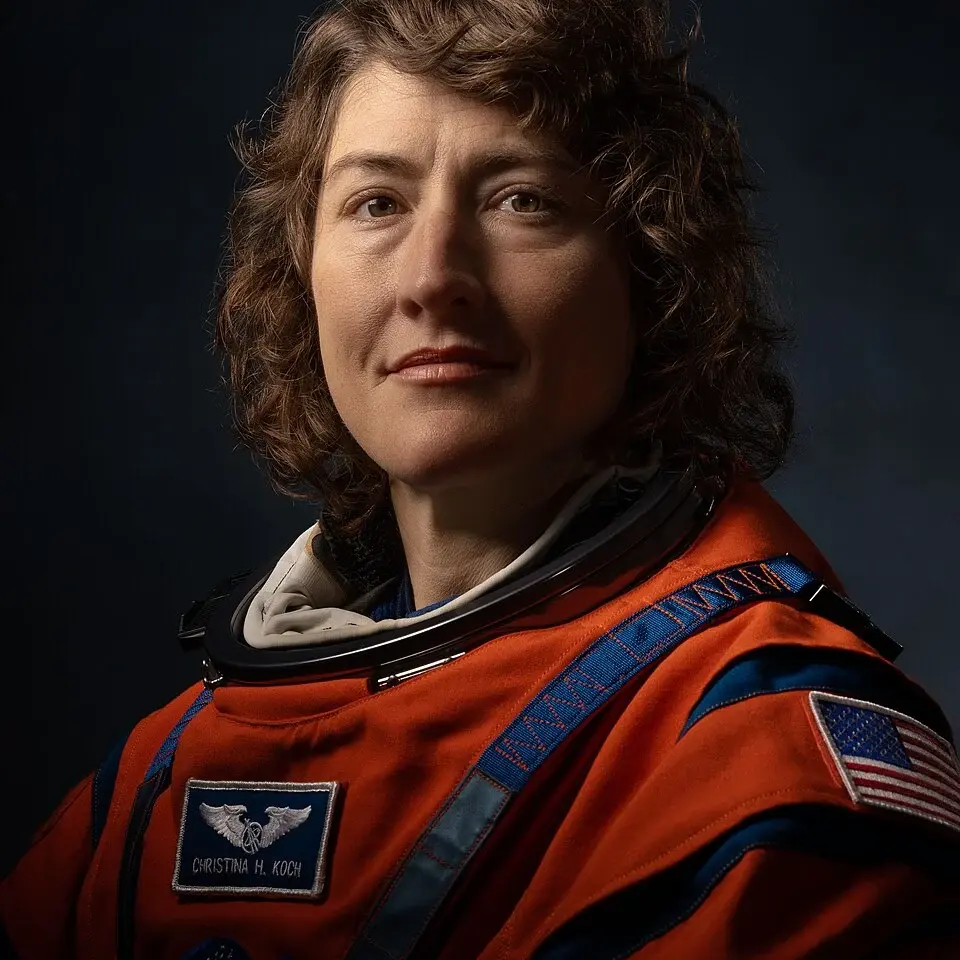
Christina Koch is an American electrical engineer, physicist, NASA astronaut, and explorer who has become one of the most accomplished women in modern space exploration. Her career combines engineering, scientific research, extreme-environment fieldwork, long-duration human spaceflight, and lunar exploration.
Koch first gained worldwide recognition after spending 328 consecutive days aboard the International Space Station (ISS) from 2019 to 2020, setting the record at the time for the longest single spaceflight by a woman. During that mission, she also participated in the first all-female spacewalk, alongside NASA astronaut Jessica Meir.
Her achievements reached another historic level in 2026. As a mission specialist on NASA's Artemis II mission, Koch became the first woman to travel around the Moon. Artemis II was the first crewed mission to travel beyond low Earth orbit since the Apollo era, taking Koch and her three crewmates on a journey around the Moon and back to Earth.
Her journey to the Moon was built on decades of work in engineering and scientific environments, including NASA laboratories, Antarctic research stations, and the International Space Station.
Christina Koch Quick Facts
Category | Details |
Full Name | Christina Hammock Koch |
Known As | Christina Koch |
Born | January 29, 1979 |
Birthplace | Grand Rapids, Michigan, USA |
Nationality | American |
Profession | NASA Astronaut, Electrical Engineer, Physicist |
Education | North Carolina State University |
Degrees | B.S. Electrical Engineering, B.S. Physics, M.S. Electrical Engineering |
NASA Selection | 2013 |
Astronaut Class | NASA Group 21 |
ISS Missions | Expeditions 59, 60 and 61 |
ISS Flight Duration | 328 consecutive days |
Spacewalks | 6 |
Spacewalk Time | About 42 hours 15 minutes |
Historic Spacewalk | First all-female spacewalk |
Lunar Mission | Artemis II |
Historic Lunar Achievement | First woman to travel around the Moon |
Artemis II Role | Mission Specialist |
Major Field Experience | Antarctic and Arctic scientific fieldwork |
Christina Koch's Education and Engineering Background
Christina Koch studied at North Carolina State University, where she earned bachelor's degrees in electrical engineering and physics. She later completed a Master of Science in electrical engineering. Her combination of engineering and physics education gave her a strong foundation for a career involving spacecraft systems, scientific instruments, and space research.
Rather than moving directly from university into the astronaut corps, Koch built extensive technical experience. She worked at NASA's Goddard Space Flight Center, where she was involved in the development of instruments for space science missions. She later worked at the Johns Hopkins University Applied Physics Laboratory, contributing to projects associated with space science and planetary research.
Her professional experience was unusually broad for an astronaut candidate because it extended beyond laboratories and spacecraft technology into some of the most remote environments on Earth.
Christina Koch's Antarctic and Remote-Field Experience
Before becoming a NASA astronaut, Christina Koch spent significant time working with the United States Antarctic Program.
Her field experience included work at Antarctic research stations, including a full winter at the Amundsen-Scott South Pole Station. Working at the South Pole required scientists and engineers to operate in an environment characterized by extreme cold, isolation, limited access, and months of darkness.
Koch's Antarctic experience became an important part of her professional background because astronauts must be capable of working effectively in isolated and demanding environments. Her experience also gave her firsthand exposure to scientific fieldwork far from conventional infrastructure.
Her career therefore developed around a fascinating combination of engineering, Earth science, extreme environments, and exploration—all areas that later became central to her work as an astronaut.
Christina Koch Becomes a NASA Astronaut
In 2013, Christina Koch was selected by NASA as part of its 21st astronaut class. She was one of eight candidates selected that year.
NASA astronaut training prepared Koch for a wide range of responsibilities, including spacecraft systems, spacewalking, robotics, scientific research, survival skills, and international spaceflight operations.
She completed her astronaut training in 2015. Her technical background and previous field experience made her particularly well suited for long-duration missions and complex scientific operations.
Christina Koch and the International Space Station
Christina Koch's first spaceflight began in March 2019, when she traveled to the International Space Station aboard a Russian Soyuz spacecraft.
She served as a flight engineer during Expeditions 59, 60 and 61, spending 328 consecutive days in orbit before returning to Earth on February 6, 2020.
Her mission became one of the most significant long-duration spaceflights ever completed by a woman.
During her time aboard the ISS, Koch and her crewmates participated in hundreds of scientific investigations involving areas such as:
Biology
Earth science
Human research
Physical science
Technology development
Plant growth
Space-based research
These experiments helped scientists understand how biological systems, materials, and technologies behave in microgravity and supported research relevant to future exploration missions.
Christina Koch's 328-Day Spaceflight Record
One of the defining achievements of Christina Koch's career was her 328-day continuous stay in space.
When she returned to Earth in February 2020, NASA described the mission as the longest single spaceflight by a woman. Koch spent approximately eleven months living and working aboard the ISS.
During that mission, she completed more than 5,200 orbits of Earth and traveled roughly 139 million miles, according to NASA.
The importance of the mission went beyond setting a record. Long-duration spaceflight provides researchers with information about how humans adapt physically and psychologically to extended periods in space. Such research is especially important for future missions to the Moon and Mars, where crews will spend much longer away from Earth.
Christina Koch and the First All-Female Spacewalk
Another defining moment in Christina Koch's career occurred on October 18, 2019, when she and NASA astronaut Jessica Meir conducted the first spacewalk performed entirely by women.
The two astronauts worked outside the International Space Station for more than seven hours while replacing a failed battery charge-discharge unit.
The achievement was historic not simply because two women were outside the spacecraft together, but because it represented an important milestone in the increasingly diverse history of human spaceflight.
Koch ultimately completed six spacewalks during her ISS mission, accumulating approximately 42 hours and 15 minutes outside the station.
Her spacewalking experience later became valuable preparation for NASA's broader exploration goals, where astronauts may need to perform complex operations around spacecraft, lunar infrastructure, and other exploration systems.
Christina Koch and Artemis II
After her historic ISS mission, Christina Koch was selected for another extraordinary assignment.
On April 3, 2023, NASA announced Koch as one of the four astronauts assigned to Artemis II, alongside commander Reid Wiseman, pilot Victor Glover, and Canadian Space Agency astronaut Jeremy Hansen.
Artemis II was designed as a crewed test flight around the Moon. Unlike missions confined to low Earth orbit, the mission would take humans much farther from Earth and test the Orion spacecraft and associated systems in the deep-space environment.
Koch served as Mission Specialist 1.
Christina Koch Becomes the First Woman to Travel Around the Moon
Artemis II launched in April 2026, carrying Koch, Reid Wiseman, Victor Glover, and Jeremy Hansen aboard NASA's Orion spacecraft.
The crew traveled around the Moon before returning safely to Earth. The mission lasted about 10 days and represented the first crewed journey beyond low Earth orbit since the Apollo era.
For Christina Koch, the mission created a historic milestone:
She became the first woman to travel around the Moon.
Her achievement also placed her among the small number of humans who have traveled beyond Earth's immediate orbital environment.
The Artemis II mission was significant for another reason: it demonstrated NASA's efforts to build a pathway toward future human exploration of the Moon and, eventually, Mars.
Christina Koch's Connection to Earth and Geography
Christina Koch's career has an unusually strong connection to geography.
Before she ever reached space, she worked in some of Earth's most extreme environments. Her Antarctic experience took her to the South Pole, one of the most isolated locations on the planet.
From there, her career expanded from Earth's polar regions to low Earth orbit and ultimately to the Moon.
Her career can therefore be viewed as a journey through different geographical scales:
Earth → Polar Regions → Low Earth Orbit → Deep Space → Moon
Her experience also demonstrates why geography remains important to space exploration. Understanding Earth, its atmosphere, polar environments, climate systems, oceans, landforms, and geographic relationships provides an important foundation for understanding our planet from space.
Koch's photographs and observations from orbit also provided a different perspective on Earth's geography, showing the planet as a connected system rather than a collection of isolated regions.
Christina Koch's Scientific Contributions
Koch's career has involved much more than simply traveling into space.
As an engineer and astronaut, she has contributed to scientific research involving Earth science, biology, human health, physical science, and technology development.
During her ISS mission, astronauts conducted experiments designed to understand how living organisms and physical processes behave in microgravity. The results can contribute to future spacecraft design, life-support systems, medical research, and long-duration exploration.
Her Antarctic fieldwork also demonstrated her ability to work directly in scientific environments where researchers must collect information under difficult conditions.
This combination of laboratory engineering, field science, and human spaceflight makes Koch's career particularly distinctive.
Christina Koch's Major Achievements
Christina Koch has achieved several historic milestones during her career.
Longest Single Spaceflight by a Woman
Koch spent 328 consecutive days in space, setting the record for the longest single spaceflight by a woman at the time.
First All-Female Spacewalk
She and Jessica Meir conducted the first all-female spacewalk in October 2019.
Six Spacewalks
Koch completed six spacewalks during her ISS mission, spending more than 42 hours outside the station.
First Woman to Travel Around the Moon
As a member of Artemis II, Koch became the first woman to travel around the Moon in 2026.
Artemis II Mission Specialist
She was one of four astronauts selected for NASA's historic Artemis II crew, representing a new generation of human lunar exploration.
2026 Princess of Asturias Award for Concord
In 2026, Christina Koch was named a recipient of the Princess of Asturias Award for Concord, recognizing her career and the broader significance of her achievements in exploration and international cooperation.
Christina Koch's Career Timeline
Year | Milestone |
1979 | Born in Grand Rapids, Michigan |
2001 | Earned B.S. in Electrical Engineering from NC State |
2002 | Earned B.S. in Physics and M.S. in Electrical Engineering |
2002–2004 | Worked at NASA Goddard Space Flight Center |
2004–2007 | Worked with the United States Antarctic Program |
2007–2009 | Worked at Johns Hopkins Applied Physics Laboratory |
2013 | Selected as a NASA astronaut |
2015 | Completed NASA astronaut training |
March 2019 | Launched toward the International Space Station |
October 2019 | Completed the first all-female spacewalk |
February 2020 | Returned to Earth after 328 days in space |
2023 | Selected for NASA's Artemis II mission |
April 2026 | Flew around the Moon on Artemis II |
2026 | Recognized with the Princess of Asturias Award for Concord |
The timeline illustrates how Koch's career progressed from engineering and polar science to orbital spaceflight and eventually lunar exploration.
Christina Koch's Legacy
Christina Koch's legacy extends beyond individual records.
Her career demonstrates how astronauts are developed through many different forms of expertise. Before reaching space, she worked as an engineer, scientific researcher, Antarctic field specialist, and space-instrument developer.
Her 328-day ISS mission expanded the record for long-duration female spaceflight, while her spacewalk with Jessica Meir became an important milestone in the history of women in space.
Her Artemis II journey then took that story much farther. By becoming the first woman to travel around the Moon, Koch became part of a new chapter in human exploration beyond low Earth orbit.
Her career also highlights the importance of international cooperation. The ISS brought together space agencies and astronauts from different nations, while Artemis II included NASA astronauts alongside Canadian astronaut Jeremy Hansen.
For future generations, Christina Koch represents the combination of science, engineering, exploration, teamwork, and persistence required to push the boundaries of human knowledge.
Explore More Geography With GeoMapGame
Christina Koch's story is closely connected with geography—from the South Pole to the International Space Station and eventually the Moon.
If you enjoy discovering countries, continents, capitals, landmarks, maps, and fascinating places around the world, you can explore more geography through GeoMapGame.
It is a fun way to test your geographical knowledge while discovering more about the world that astronauts like Christina Koch observe from above.
Frequently Asked Questions About Christina Koch
Who is Christina Koch?
Christina Koch is an American electrical engineer, physicist, NASA astronaut, and explorer known for her record-setting ISS mission, historic spacewalks, and participation in NASA's Artemis II lunar mission.
When was Christina Koch born?
Christina Koch was born on January 29, 1979, in Grand Rapids, Michigan, USA.
What did Christina Koch study?
She studied electrical engineering and physics at North Carolina State University and earned a master's degree in electrical engineering.
When did Christina Koch become a NASA astronaut?
Christina Koch was selected as a NASA astronaut in 2013 as part of NASA's 21st astronaut class.
How long did Christina Koch stay in space?
Koch spent 328 consecutive days aboard the International Space Station during her first spaceflight, from 2019 to 2020.
What record did Christina Koch set?
She set the record at the time for the longest single spaceflight by a woman, spending 328 consecutive days in space.
Was Christina Koch part of the first all-female spacewalk?
Yes. On October 18, 2019, Christina Koch and Jessica Meir conducted the first all-female spacewalk.
How many spacewalks did Christina Koch complete?
Christina Koch completed six spacewalks, totaling approximately 42 hours and 15 minutes outside the International Space Station.
What was Christina Koch's role on Artemis II?
She served as Mission Specialist 1 on NASA's Artemis II mission, alongside Reid Wiseman, Victor Glover, and Jeremy Hansen.
Was Christina Koch the first woman to travel around the Moon?
Yes. Christina Koch became the first woman to travel around the Moon as part of NASA's Artemis II mission in 2026.
Conclusion
Christina Koch's biography is a story of exploration across Earth and beyond. From engineering laboratories and the frozen environment of Antarctica to nearly a year aboard the International Space Station and ultimately a journey around the Moon, her career has crossed some of the most challenging environments humans can experience.
Her 328-day ISS mission, first all-female spacewalk, six spacewalks, and historic Artemis II lunar journey have made Christina Koch one of the most notable astronauts of her generation.
More importantly, her career demonstrates that major achievements in exploration are built on education, engineering, scientific curiosity, teamwork, and the willingness to work in unfamiliar environments.
From the South Pole to the Moon, Christina Koch's journey represents the continuing expansion of human exploration.


Comments